
















































































370% Surge in Heat Deaths for Elderly by 2050—Experts Warn Nigeria Is on the Frontline

By Orbit News 24 Environment Desk
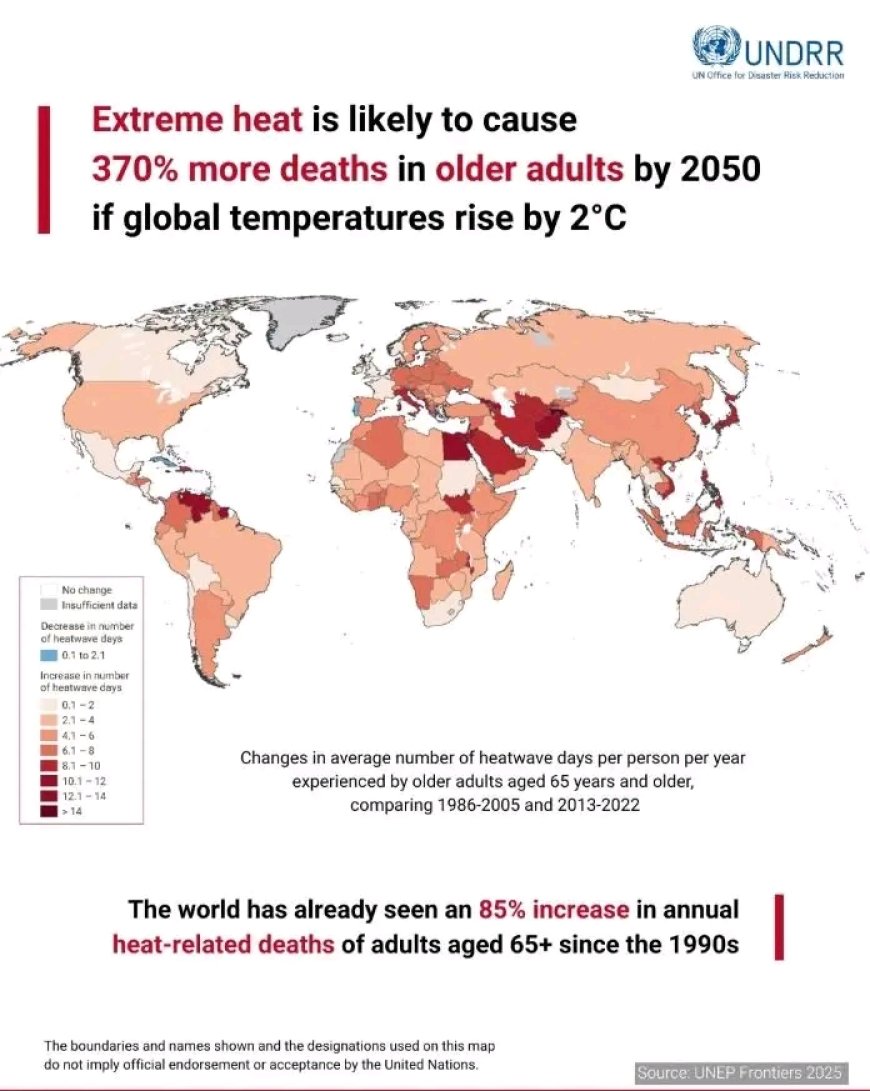
As the world grapples with rising temperatures, a stark new climate projection has sounded the alarm for Nigeria: a global temperature increase of just 2°C could trigger a 370% rise in heat-related fatalities among the elderly population by 2050. While the threat is global, environmental and health experts are warning that Nigeria—particularly its northern states—stands on the frontline of this looming crisis.
The data, highlighting "heightened climatic sensitivity" in regions including Sub-Saharan Africa, suggests that without urgent intervention, the combination of an aging population and intensifying heatwaves could overwhelm communities already battling desertification and resource scarcity.
Gombe and the Dryland Corridor at "Highest Risk"
Local environmental groups are pinpointing states like Gombe as potential epicenters of this heat crisis. The Gombe State chapter of the JEWEL Environmental Initiative has expressed deep concern over the findings, noting that the dryland corridor is already experiencing shifts in weather patterns that endanger both agricultural livelihoods and human health.
"We are talking about a public health emergency that is creeping up on us," said a senior coordinator at JEWEL Environmental Initiative. "In many parts of Northern Nigeria, the architecture, the urban planning, and the current healthcare infrastructure were not designed for the extreme temperatures that a 2°C world will bring. Our elderly, who often have underlying health conditions, will be trapped in homes that turn into ovens."
ACReSAL: Adaptation Through Restoration
In response to the growing threat, projects focused on landscape restoration are being re-evaluated as critical health interventions. The Gombe State - ACReSAL (Agro-Climatic Resilience in Semi-Arid Landscapes) project is emerging as a key player in mitigating these risks.
Sources within the project indicate a strategic shift to link environmental restoration directly with public health outcomes. "When we plant trees within community perimeters or restore degraded land around villages, we aren't just fighting desertification—we are creating thermal refuges," a project insider explained. "Every canopy that shades a compound is a small clinic against heatstroke. ACReSAL’s work is becoming the physical infrastructure of climate adaptation."
The Abuja Disconnect: Calls for Policy Overhaul
While the impact will be felt locally, the policy response is being directed from Abuja. The National Council on Climate Change (NCCC) is facing renewed pressure to move beyond carbon accounting and into aggressive, life-saving adaptation strategies.
Public health advocates are urging the NCCC to collaborate with the Federal Ministry of Health to draft "Heat Health Action Plans." These would include early warning systems for heatwaves, the redesign of urban housing to improve passive cooling, and public awareness campaigns specifically targeted at caring for the elderly during extreme temperature spikes.
"This isn't just an environmental statistic; it is a medical prognosis for our nation," said a policy analyst tracking the NCCC's progress. "A 370% increase in deaths is not a 'change'—it is a catastrophe. We need to see urban design mandates from the government that mandate green spaces and reflective building materials in new housing estates. We need to see the UN Environment Programme and UN Climate Change frameworks translated into local government budgets."
A Global Warning with Local Urgency
The findings serve as a grim reminder that climate change is fundamentally a health crisis. As the UN Environment Programme and international bodies push for emissions cuts, Nigerian stakeholders argue that adaptation can no longer be an afterthought.
For the elderly in Gombe, and across the vulnerable belt of South Asia, the Middle East, and the Sahel, the next 25 years will determine whether the future holds a livable environment or a deadly gamble with rising temperatures.
Orbit News 24 will continue to monitor how federal and state governments respond to this escalating threat.
Source: Umar Yahaya (Facebook)
What's Your Reaction?
 Like
0
Like
0
 Dislike
0
Dislike
0
 Love
0
Love
0
 Funny
0
Funny
0
 Angry
0
Angry
0
 Sad
0
Sad
0
 Wow
0
Wow
0