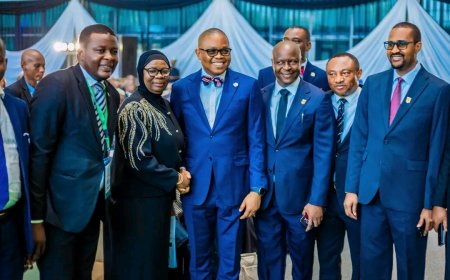
The Federal Government has reiterated its commitment to expanding digital inclusion and ensuring meaningful connectivity across Nigeria to accelerate national development.
Speaking at a Universal Service Provision Fund (USPF) stakeholders’ event organised by the Nigerian Communications Commission in Abuja, the Minister of Communications, Innovation and Digital Economy, Bosun Tijani, said the government is focusing not only on access to telecommunications but also on how citizens utilise digital connectivity.
According to Tijani, Nigeria has witnessed significant progress in the telecom sector since the introduction of GSM, with services now more accessible and affordable.
“Connectivity is now almost ubiquitous compared to the early days when even acquiring a SIM card was expensive,” he said.
He revealed that the government plans to deploy about 90,000 kilometres of fibre optic cable and build approximately 4,000 telecommunications towers nationwide—an investment he described as unprecedented among developing countries.
Despite these gains, Tijani noted that millions of Nigerians, particularly in rural and underserved areas, still lack adequate connectivity.
He praised the USPF for its efforts in bridging this gap through the deployment of telecom infrastructure and the establishment of computer laboratories in schools. However, he stressed the need to shift focus from mere access to meaningful usage.
“It is not enough to connect communities; we must ensure that people benefit. Schools should use digital tools effectively, and small businesses must access wider markets,” he said.
The minister highlighted a pilot project in Kura community near Abuja, where about 12,000 residents previously without telecom access are now connected. The initiative linked schools and healthcare facilities and enabled farmers to engage directly with buyers through digital platforms.
He added that similar interventions would be extended to about 4,000 communities nationwide, with particular attention to northern Nigeria where connectivity gaps remain widest.
Tijani also underscored the importance of digital literacy, affordable devices, and sustainable implementation models, urging stakeholders to focus on real-life impact.
“We must measure success by how many lives are improved, not just the number of projects delivered,” he said.
In his remarks, the Executive Vice-Chairman of the NCC, Aminu Maida, called on the USPF board to intensify efforts toward achieving meaningful connectivity.
Maida noted that although telecommunications usage has grown by about 160 percent in the past two years, much of the growth is concentrated in urban areas, widening the digital divide.
“The gap between those who are connected and those who are not meaningfully connected continues to grow,” he said.
He emphasised that infrastructure alone is not enough, stressing the need for platforms that enable productivity and economic growth beyond social media use.
Maida expressed optimism that the USPF board would drive impactful initiatives to strengthen Nigeria’s digital economy, empower citizens, and ensure that no community is left behind.





















































































 Like
0
Like
0
 Dislike
0
Dislike
0
 Love
0
Love
0
 Funny
0
Funny
0
 Angry
0
Angry
0
 Sad
0
Sad
0
 Wow
0
Wow
0